
Darknet marketplace
A darknet marketplace is a commercial website that operates on an anonymity network, most often Tor. The term entered common use after the 2011 launch of Silk Road.
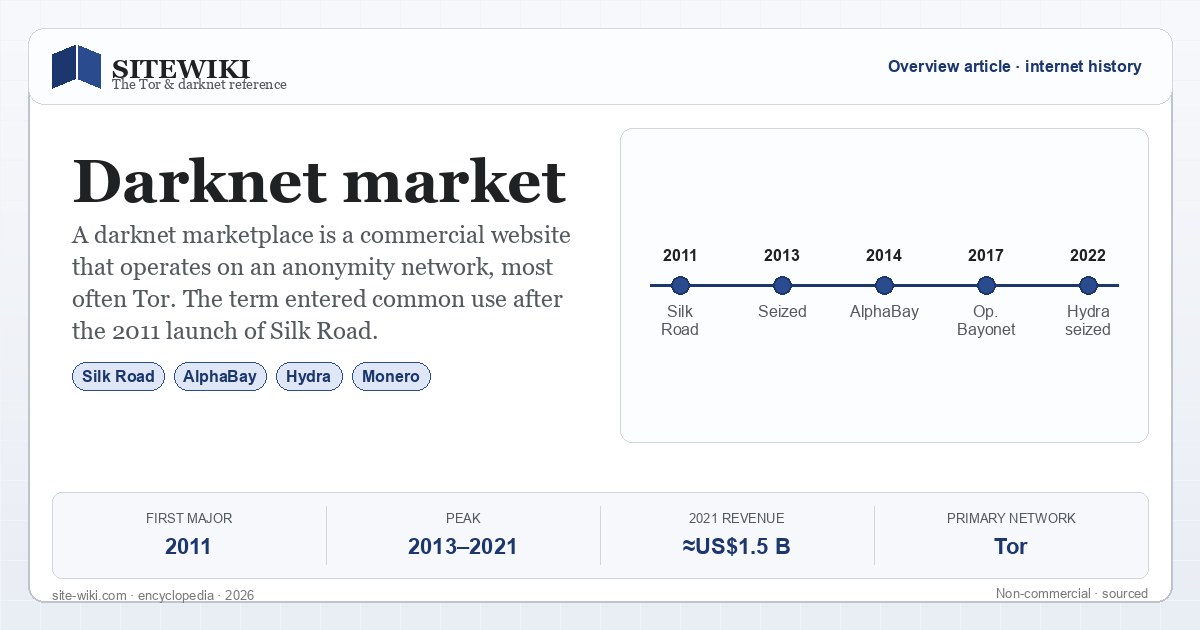
A darknet marketplace is a commercial website that operates as an onion service on the Tor network. The term entered mainstream usage after the launch of Silk Road in February 2011, when the combination of Tor and the then-new cryptocurrency Bitcoin enabled an anonymous e-commerce model. Darknet markets have been the subject of academic measurement, major law-enforcement operations and extensive journalism.
Definition
Researchers at Carnegie Mellon University and the University of Montreal define a darknet marketplace as a hidden-service website that provides a listing index, an escrow or multisignature payment facility and a dispute resolution mechanism. [1] The definition excludes individual vendor shops and specialised forums that do not act as intermediaries.
Historical overview
- 2011–2013 — Silk Road operates openly on Tor and demonstrates the viability of a Bitcoin-paid marketplace.
- 2013–2015 — Market multiplication: Sheep Marketplace, Black Market Reloaded, Evolution and Agora emerge after the Silk Road shutdown. Agora becomes the largest English-language market in 2015 before closing voluntarily.
- 2015–2017 — AlphaBay dominates the Western market. The Russian-language Hydra Market reaches a market share above 80 % in its region.
- July 2017 — Operation Bayonet takes down AlphaBay and Hansa in a coordinated U.S./European operation. Users scattering to Dream Market and smaller competitors.
- 2018–2022 — Fragmentation. Dream, Wall Street, Empire, DarkMarket and Hydra all exit under seizure, voluntary closure or operator theft.
- 2022–2024 — Shift to privacy-coin-only markets (Monero), smaller operators and no clear dominant successor to Hydra.
Typical structure
A full-service market combines a listings catalogue, a wallet system, a messaging layer with built-in PGP support and a dispute-resolution process overseen by moderators. Vendors typically pay a bond; buyers deposit cryptocurrency into escrow before an order is finalised. Reputation is tracked through aggregate feedback and sometimes through imported ratings from previous marketplaces.
Payments and escrow
Early markets used ordinary single-signature escrow: funds were held by the market until the buyer confirmed receipt. From 2013 onwards most reputable markets adopted 2-of-3 Bitcoin multisig, which allows funds to be released by any two of buyer, vendor and market. Monero-based multisig became production- ready in 2020 but is less widely used because of the complexity of its handshake.
Academic measurement
Longitudinal studies by Soska and Christin (2015) [2], EUROPOL (annual IOCTA reports) and the United Nations Office on Drugs and Crime provide the main public data on sales volumes. Chainalysis estimated darknet-market revenue at roughly US$1.5 billion in 2021, with Hydra accounting for the majority of that total.
Decline and fragmentation
Successive law-enforcement operations — Operation Bayonet (2017), Operation DisrupTor (2020), Operation Dark HunTor (2021) and the April 2022 BKA seizure of Hydra — have made long-term market operation increasingly costly. Operator exit scams and voluntary closures, such as Dream Market in 2019, further eroded user trust. Measurement work after 2022 has documented a shift to smaller, often invitation-only communities and a general preference for Monero over Bitcoin.
References
- Décary-Hétu, David; Giommoni, Luca (2017). “Do Police Crackdowns Disrupt Drug Cryptomarkets?” Crime, Law and Social Change, 67(1).
- Soska, Kyle; Christin, Nicolas (2015). “Measuring the Longitudinal Evolution of the Online Anonymous Marketplace Ecosystem.” Proceedings of USENIX Security 2015.
- EUROPOL (2023). Internet Organised Crime Threat Assessment (IOCTA) 2023.