
Silk Road (marketplace)
Silk Road was the first major modern darknet marketplace, operating as a Tor onion service from February 2011 until it was seized by the United States Federal Bureau of Investigation in October 2013.
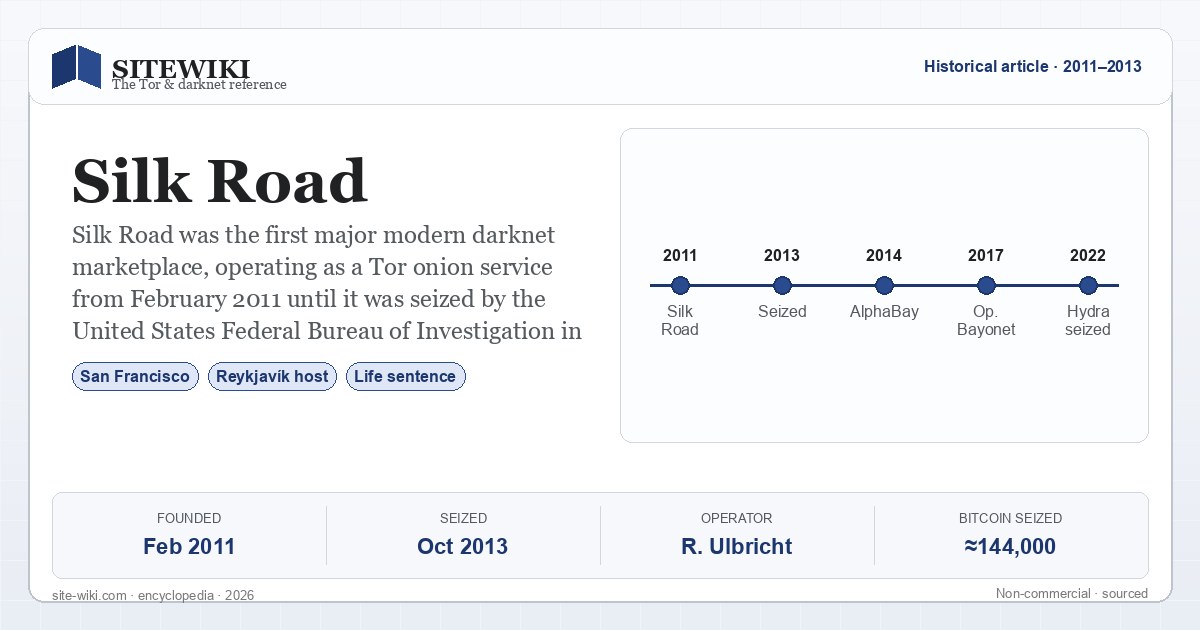
Silk Road was a darknet marketplace launched in February 2011 by Ross William Ulbricht, a 26-year-old American physicist and libertarian. It was the first large modern market of its kind, combining Tor onion routing with Bitcoin escrow, and is widely credited with establishing the template that later markets followed. Silk Road was seized by the United States Federal Bureau of Investigation (FBI) on 2 October 2013 after a two-year investigation that spanned the Internal Revenue Service, Homeland Security Investigations and the Drug Enforcement Administration.
Founding and growth
Ulbricht began work on the site, which he described in private writings as “an economic experiment,” in late 2010 and launched a limited beta on 1 February 2011. A June 2011 article in Gawker brought the market mainstream attention and prompted the first congressional letters to law enforcement. [1] Within two years Silk Road listed more than 13,000 products across dozens of categories; the Carnegie Mellon longitudinal study later estimated monthly turnover of roughly US$1.2 million in early 2012.
Operation and policies
Silk Road enforced a published policy that prohibited the sale of weapons, child sexual abuse material, stolen financial information and services intended to defraud or harm. Vendor accounts cost US$500 initially and were subject to community reputation. All transactions were held in Bitcoin escrow, with the market taking a commission that ranged from 10 % on small orders down to about 1.5 % on large ones. A built-in tumbler randomised on-chain movements to make tracing harder.
FBI investigation
Investigators began a formal case in 2012. Agents built a profile of “Dread Pirate Roberts” from forum posts that linked an early Silk Road announcement on bitcointalk.org to a Gmail account registered under Ulbricht’s real name, and from a 2013 package of forged identity documents intercepted at the U.S.–Canada border. [2] A U.S. district court unsealed in September 2013 described the chain of evidence in detail. Two federal agents attached to the case, Carl Mark Force IV (DEA) and Shaun Bridges (U.S. Secret Service), were later convicted of stealing bitcoin from the operation.
Seizure and arrest
On 1 October 2013 Ulbricht was arrested in a public library in San Francisco while logged in to Silk Road as the administrator. The FBI simultaneously served legal process on servers in Iceland and seized the market’s wallet, which contained roughly 144,000 BTC (≈US$28 million at the time).
Trial and sentence
Ulbricht was tried in the U.S. District Court for the Southern District of New York. On 4 February 2015 the jury returned a guilty verdict on seven counts, including conspiracy to traffic narcotics, money laundering and computer hacking. On 29 May 2015 Judge Katherine Forrest sentenced him to two consecutive life sentences plus 40 years, without the possibility of parole. The United States Court of Appeals for the Second Circuit upheld the conviction and sentence in May 2017.
Legacy
Silk Road’s mechanical design — Tor onion service, Bitcoin escrow, vendor reputation, PGP-based buyer communication — became the standard template for darknet markets that followed. Silk Road 2.0 opened in November 2013 and was itself seized in November 2014 as part of Operation Onymous; its operator Blake Benthall was arrested in San Francisco. Later markets such as Evolution, Agora and AlphaBay inherited many of Silk Road’s conventions.
Ulbricht’s case has been the subject of books, documentaries and a long-running clemency campaign. In January 2025 the U.S. President commuted his life sentence to time served.
References
- Chen, Adrian (1 June 2011). “The Underground Website Where You Can Buy Any Drug Imaginable.” Gawker.
- United States v. Ross William Ulbricht, criminal complaint, Southern District of New York, September 2013.
- Bearman, Joshuah (2015). “The Rise and Fall of Silk Road.” Wired.
- United States v. Ulbricht, 858 F.3d 71 (2d Cir. 2017).