
Torzon Market
Three verified Torzon Tor v3 mirrors are on a separate page. Primary first, one-click copy.
Torzon onion links →Torzon Market is a Tor-based darknet marketplace that opened in 2022, offering multi-currency escrow and a comparatively large mirror ring.
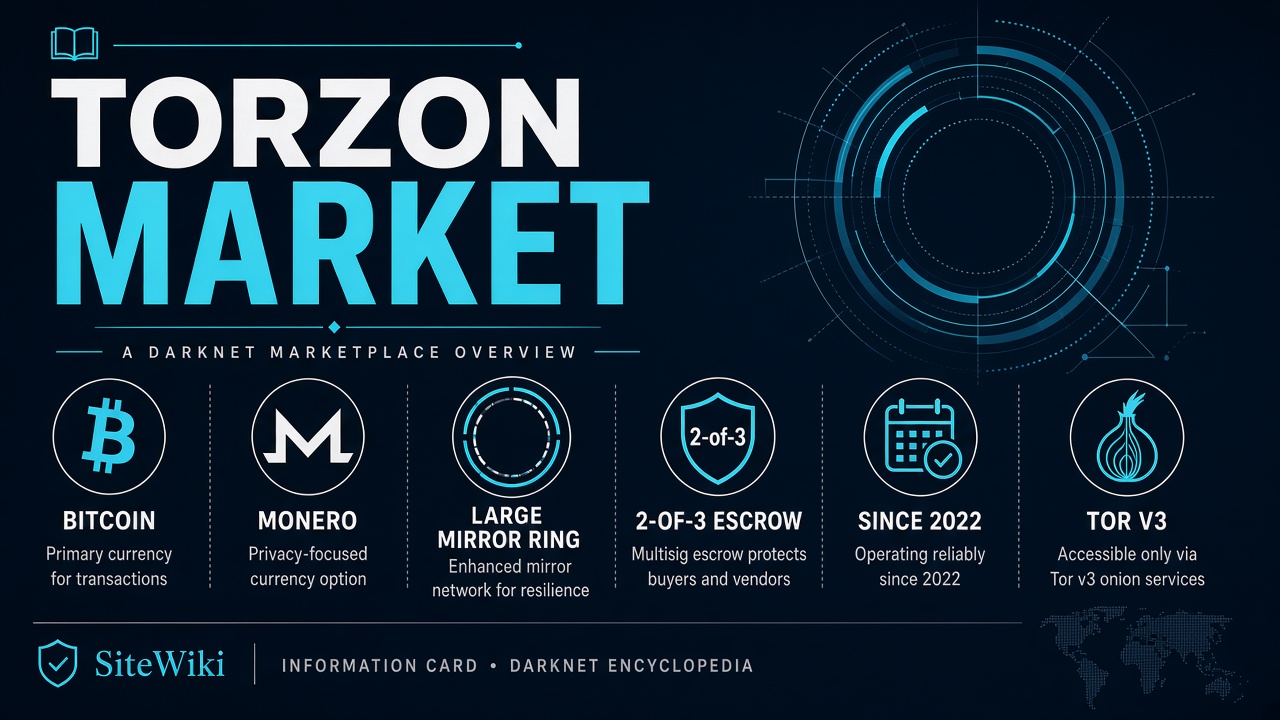
Torzon Market is a darknet marketplace that opened on Tor in 2022. It is an English-language general-purpose platform that supports both Bitcoin and Monero, and is noted among researchers for operating a larger-than-average set of mirror onion addresses.
Torzon is one of several mid-sized markets that opened in the fragmented ecosystem that followed the 2022 takedown of Hydra. Unlike the contemporaneous BlackOps, which chose a Monero-only path, Torzon kept Bitcoin to lower the barrier to entry for buyers who did not yet hold the privacy coin.
Background
By 2022 the Western darknet market ecosystem had experienced successive setbacks: Operation Bayonet in 2017, Operation DisrupTor in 2020 and Operation Dark HunTor in 2021 had each produced significant arrests and lowered user trust in large single-market dominance. In parallel, the April 2022 seizure of Hydra closed the largest Russian-language platform. Smaller operators, including Torzon, filled the vacuum rather than any single successor.
History
Torzon opened quietly in mid-2022 and grew by referrals on Dread and smaller onion-service forums. By mid-2023 it had accumulated several thousand active vendor accounts, according to independent trackers. [1] In 2024 a brief uptime incident, attributed to a denial-of-service campaign targeting individual mirrors, prompted the operators to expand the mirror ring and publish a new PGP-signed canary with each refresh.
Design
The web interface is server-rendered HTML with optional small JavaScript widgets (cart counters) that degrade gracefully. Vendor pages carry a tabulated listing table, a plain-text policy block signed by the vendor and a feedback section. The site uses onion v3 addresses throughout; see Onion service v3 for the underlying protocol.
Payment and escrow
Both Bitcoin and Monero are accepted. For orders above a configurable value, the market generates a 2-of-3 multisignature wallet as the deposit address and the buyer, vendor and market each hold one of the three keys. For low-value or beta orders, classical escrow is still offered.
Vendor policies
Vendor bonds are required and are refundable only after a configurable sales threshold. Vendors are prohibited from selling categories that are consistently listed as banned across post-Bayonet markets: firearms, counterfeit identity documents, services targeting unaffiliated individuals and child sexual abuse material.
Mirror infrastructure
Torzon’s mirror ring is relatively large. Multiple mirror addresses have been cited by independent trackers; the operators maintain a canary with the canonical list and rotate it after any incident. A large mirror ring improves resilience against denial-of-service and takedown, but it also increases the surface for phishing clones: an attacker can register a vanity address whose prefix resembles one of the many legitimate mirrors.
Security considerations
Write-ups about this market repeat a general warning about clone sites. The pattern is described in Phishing and clones.
Reception
Torzon is referenced in the 2023 and 2024 editions of EUROPOL’s Internet Organised Crime Threat Assessment [2] and in the Chainalysis Crypto Crime Report series. It has not been the subject of a dedicated academic study.
See also
References
- Chainalysis (2023). Crypto Crime Report 2023.
- EUROPOL (2024). Internet Organised Crime Threat Assessment (IOCTA) 2024.
- United Nations Office on Drugs and Crime (2023). World Drug Report 2023, chapter on cryptomarkets.