
Monero and privacy coins
Monero (XMR) is a cryptocurrency designed around transaction privacy by default. It is widely used on darknet markets and is the subject of ongoing law-enforcement research.
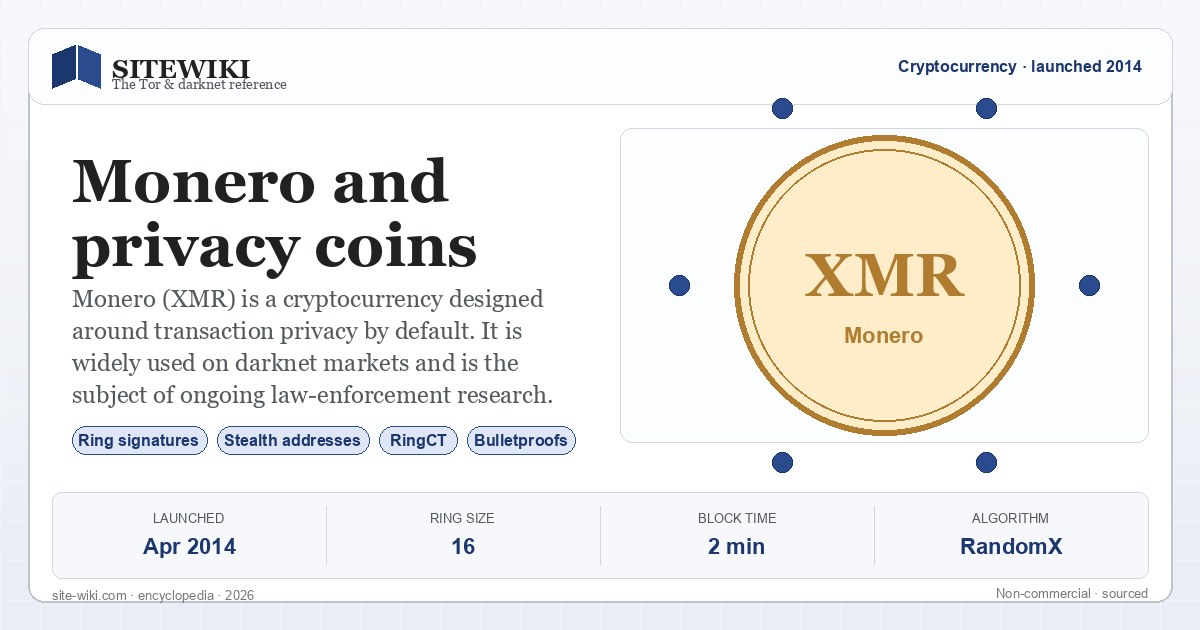
Monero (symbol XMR) is a decentralised cryptocurrency released on 18 April 2014 as a fork of Bytecoin, itself an implementation of the CryptoNote protocol. It is designed around transaction privacy by default: the sender, the recipient and the amount of every transaction are all hidden from on-chain observers. Monero is widely used on darknet markets and is the subject of ongoing research by both academic groups and blockchain-analysis firms.
Background
CryptoNote was proposed in 2013 under the pseudonym Nicolas van Saberhagen. Bytecoin was the first implementation but was criticised for a controversial pre-mine. A fork without the pre-mine was launched as BitMonero in April 2014 and renamed Monero (Esperanto for “coin”) a few weeks later. The project has no formal foundation and is maintained by a rotating group of core developers under the Monero Research Lab.
Design
- Ring signatures hide the real sender among a group of decoys. Since January 2022 Monero has used CLSAG with a ring size of 16.
- Stealth addresses ensure that each payment goes to a one-time address indistinguishable from any other, so recipients are not linkable on-chain.
- RingCT (ring confidential transactions, deployed in 2017) hides the amount of every transaction using Pedersen commitments and bulletproof range proofs.
- The network uses an ASIC-resistant proof-of-work algorithm, RandomX, intended to remain mineable on general-purpose CPUs.
Darknet adoption
Several large markets accepted Monero in parallel with Bitcoin from 2017 onward, but the 2021 relaunch of AlphaBay was the first large market to be Monero-only. A number of Russian-language successors to Hydra followed the same policy in 2022–2024. Researchers at Chainalysis and Elliptic have noted a measurable shift of darknet turnover from Bitcoin to Monero over this period.
Analysis and research
Published academic attacks on Monero have exploited early implementation weaknesses: a 2017 paper by Miller et al. demonstrated statistical de-anonymisation of pre-RingCT transactions, and subsequent work has studied timing attacks and the risk of mining-pool decoy sampling. The U.S. Internal Revenue Service solicited and awarded a US$625,000 contract for Monero-tracing tooling in 2020; the extent to which production tooling exists remains disputed.
Other privacy coins
Zcash (ZEC, 2016) uses zero-knowledge proofs to allow optional fully shielded transactions; adoption on darknet markets has remained low because most transactions on the Zcash network are, in practice, transparent. Dash (2014) and PIVX (2016) implement mixing features but are not formally classified as privacy coins by the Financial Action Task Force.
References
- van Saberhagen, Nicolas (2013). CryptoNote v 2.0. cryptonote.org.
- Miller, Andrew et al. (2017). “An Empirical Analysis of Linkability in the Monero Blockchain.” Proceedings on Privacy Enhancing Technologies, 2018(3).
- Noether, Shen; Mackenzie, Adam (2016). “Ring Confidential Transactions.” Ledger, Vol. 1.
- U.S. IRS, Criminal Investigation Division (2020). Request for proposal: Monero tracing contract.