
The Tor network
The Tor network is a volunteer-operated system of relays that provides anonymous internet communication through onion routing. It is maintained by the non-profit Tor Project and is widely used by journalists, researchers and ordinary users.
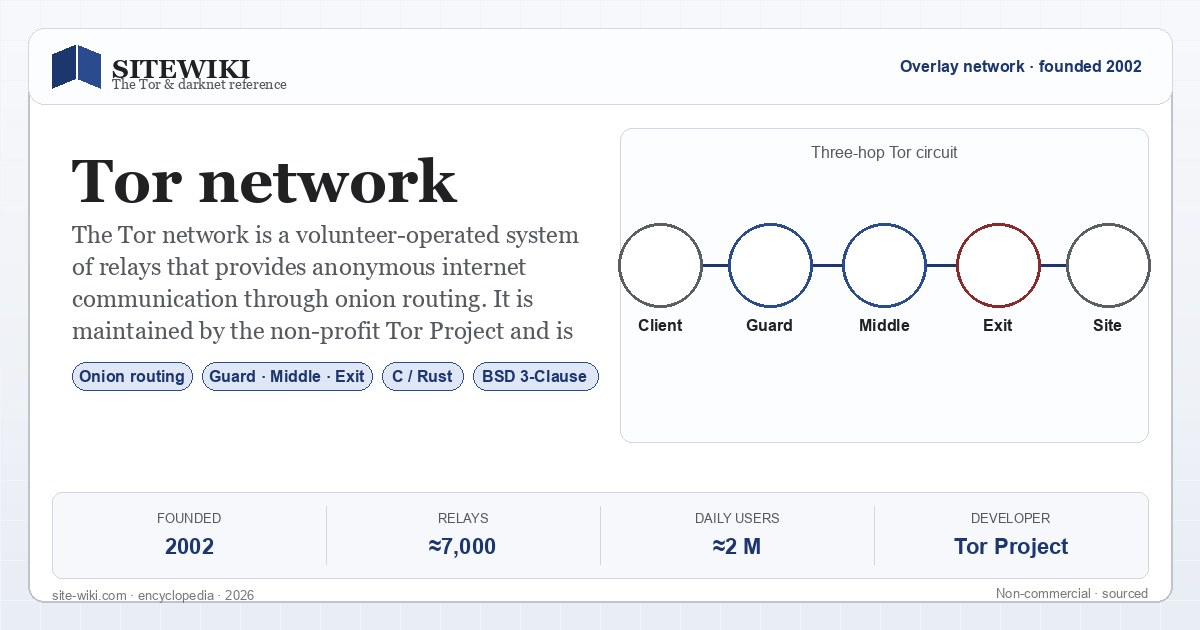
Tor (an acronym for The Onion Router) is a free and open-source overlay network for anonymous communication. Traffic is relayed through a volunteer-operated circuit of three servers, so no single relay knows both the sender and the destination. The project grew out of research on onion routing conducted at the United States Naval Research Laboratory in the 1990s and became an independent non-profit, the Tor Project, in 2006.[1]
As of 2024 the public Tor network consists of roughly 6,500–7,000 relays and is used by an estimated two million daily clients.[2] It is funded primarily by grants from the U.S. State Department, the Open Technology Fund, the Swedish International Development Cooperation Agency and private donations.
History
Onion routing was proposed in 1995 by Paul Syverson, Michael Reed and David Goldschlag of the U.S. Naval Research Laboratory, and the first public implementation of Tor was released in September 2002 by Syverson and Massachusetts Institute of Technology graduates Roger Dingledine and Nick Mathewson.[3]
In 2004 the project was released under a free licence and received financial support from the Electronic Frontier Foundation. The Tor Project, Inc. was incorporated as a 501(c)(3) non-profit in Massachusetts in 2006. In 2008 the first version of Tor Browser Bundle was released, lowering the technical barrier for ordinary users.
How onion routing works
When a Tor client contacts a website, it builds a circuit of three relays chosen from the public directory: a guard, a middle and an exit. The client negotiates a shared key with each relay using an authenticated Diffie–Hellman handshake and then encrypts the outgoing message in three nested layers of symmetric encryption. Each relay peels off one layer, hence the metaphor of an onion.
- The guard relay sees the client’s IP address but not the final destination.
- The middle relay sees neither.
- The exit relay sees the destination and the unencrypted request, but not the client’s IP.
Circuits are rebuilt roughly every ten minutes. Guard relays are rotated more slowly (months) to resist long-term statistical de-anonymisation.
Relays, bridges and directory authorities
The Tor consensus is produced every hour by nine directory authorities, operated by trusted volunteers in several jurisdictions. Relays voluntarily publish their descriptor and bandwidth, which authorities verify through active measurement.
Users in networks that block the public relay list can use bridges — unlisted relays reachable through side channels such as e-mail, Telegram or the Tor Project’s web form. Pluggable transports such as obfs4, meek, Snowflake and WebTunnel disguise Tor traffic to look like ordinary TLS or WebRTC.
Tor Browser
Tor Browser is a hardened fork of Mozilla Firefox Extended Support Release maintained by the Tor Project. It ships with the Tor client, NoScript and a strict first-party isolation policy; fingerprinting defences such as a letterboxed window and reduced timing resolution reduce the user’s uniqueness among the browser population.
Legitimate uses
Tor is used by journalists working with sources in authoritarian countries (for example through SecureDrop, which the Freedom of the Press Foundation deploys for newsrooms including The New York Times, The Guardian and ProPublica), by human-rights researchers and by law-enforcement agencies conducting on-line investigations. Many mainstream services operate onion mirrors, including the BBC World Service, Deutsche Welle, The New York Times, Facebook, GitHub and ProtonMail.
Limitations and attacks
Tor does not protect against application-layer leaks, browser exploits or user mistakes. Published research has demonstrated end-to-end timing correlation attacks when an adversary observes both ends of a circuit, as well as deanonymisation through browser bugs delivered by state actors. Guard-discovery and traffic-confirmation attacks remain the subject of active academic study.[4]
References
- Dingledine, Roger; Mathewson, Nick; Syverson, Paul (2004). “Tor: The Second-Generation Onion Router.” Proceedings of the 13th USENIX Security Symposium.
- Tor Project. “Tor Metrics — Users.” metrics.torproject.org (retrieved 2024).
- Reed, Michael G.; Syverson, Paul F.; Goldschlag, David M. (1998). “Anonymous Connections and Onion Routing.” IEEE Journal on Selected Areas in Communications, 16(4).
- Johnson, Aaron et al. (2013). “Users Get Routed: Traffic Correlation on Tor by Realistic Adversaries.” ACM CCS 2013.